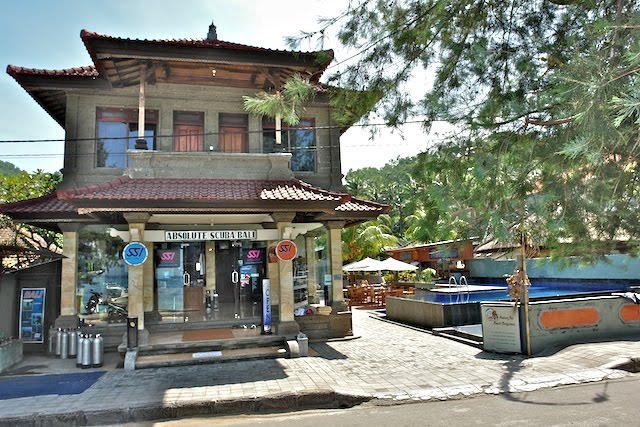
Absolute Scuba Bali

Absolute Scuba Bali
Shop front

Sunday, November 21, 2010

Are you eco-friendly??


As we rapidly approach 7 billion members of this human population, our activities and use of energy and resources are having an increased effect upon the ability of the Earth to sustain us. Coral reefs are a vital indicator of the overall health of the planet and most are currently flashing red.

Existing within precisely defined, narrow physical and chemical limits, these ancient ecosystems are highly sensitive to changes in the Earth’s climate. Around two thirds of global reef systems have already gone, the rest threatened or in serious decline.

The reasons are numerous and complex, but pollution from land-based activities, increases in seawater temperature and abnormal levels of predation, caused by human removal of key species, add to the rate of loss of these elements.

The world has discovered that our wonderful sharks, these magnificent creatures which have gone from predator to prey, and how despite surviving the earth's history of mass extinctions, they could easily be wiped out within a few years due to human greed.

Are you doing your bit for conservation and support?

We need to:

Look after the environment

• do not touch the coral or any marine life
• do not collect live shells, coral or fossils
• do not feed fish or other marine life
• do not attempt to capture or trap marine life
• leave no rubbish or debris
• take only pictures, leave only bubbles

Write to your politician, boycott countries which sell shark products, do not buy marine objects promoted to tourists etc etc

or join Sea Shepherd and become an underwater spy! : http://www.seashepherd.org/

Wednesday, November 10, 2010

Technical diving


Xtreme Excitement

SSI’s TechXR is a well founded Technical Diving program and it was created to take the recreational diver to an extreme level for their diving adventures.
Whether you are looking for the excitement of deep reef diving or the thrill of exploring wrecks located well past 40m (130 feet), SSI TechXR is a way to learn the training and experience necessary for you to complete every new adventure with confidence and skill.
Whatever your current diving ability, extended range diving will challenge you with environments, depths, bottom times, procedures, and equipment not commonly encountered by recreational divers. You will be experiencing advanced levels that require extensive knowledge, enhanced diving skills, and considerable experience.

Xtreme Training

To support your journey, SSI has developed specific learning tools: a manual, interactive CD-ROM, Technical DiveLog and Technical Dive Slates. In addition, your instructor may also require you to have a personal copy of an advanced dive planning software program.
The courses available for you to take are: Advanced Nitrox, Technical Foundations, Decompression Procedures, Normoxic Trimix, and Advanced Decompression Procedures. You can take each of these courses individually or all at once.
You will develop confidence and comfort with these new skills through repetition and supervised experiences. Training will be designed to match your goals and objectives. SSI′s signature training method′s the "SSI Diver Diamond "and "Comfort Through Repetition" have been applied to keep the programs consistent and provide the same high quality education as other SSI products.

Please email Absolute Scuba to arrange your Tech diving future

Saturday, October 23, 2010

Drift diving


Drift diving is a popular form of diving which is defined not by equipment or technique, but by location and water currents. In most open water diving situations the scuba diver propels himself by swimming and kicking the fins. In drift diving the diver descends into water with a known current and after obtaining neutral buoyancy lets the current just carry him along.

Drift diving is arguably the most relaxing and pleasant diving experience there is. Because the diver is not exerting himself by swimming, he uses less air and thus can stay submerged longer on a single tank. Many popular drift diving reefs have currents which run parallel to the reef; once submerged the diver relaxes and watches the scenery float by; using only minimal effort to stay neutral and navigate around formations.

The whole point of drift diving is to "go with the flow" and not to swim against the current. The movement is often so gentle that divers don't realize how powerful the current is; but they may soon realize its force when trying to swim against it! With a group of divers swimming into the current differences in swimming strength and fitness quickly become apparent since some divers swim easily upstream while others struggle to keep up. Going with the current a large group of divers can stay together very easily. Regardless of fitness level or swimming strength swimming against a strong current will use more air and the exertion of fighting the current shortens the diving experience.

Drift diving is almost always done from a boat drop-off, you must have someone on board to follow you. Once you begin drifting you will be carried quickly away from your drop-off point - often much more quickly than you realize or expect. It is very important for the boat captain to know which way the current is flowing and follow you from above. In calmer water (especially with larger groups of divers) the boat captain can see your bubbles and follow them. It is a very good idea for your group to have a surface marker buoy, on a reel, that you can send up when you begin to ascend - the boat will see it and approach to pick you up.

Bali water have many drift diving sites, especially on the Nusa Penida side of the island; Ped, S.D, Sental, Toyapaka, to name just a few. Enjoy your diving.

Saturday, October 2, 2010

Nudibranch facts


We've all seen these colourful little critters whilst diving, but how many of us actually know some facts about them:

What is a nudibranch or sea slug? Although the term “slugs” conjures up all kinds of unpleasant ideas, nudibranchs (pronounced “noo-dee-branks”), more commonly known as sea slugs, are renowned for their boundless variety and beauty. Nudibranchs are gastropod molluscs.

What do they look like? Nudibranchs are shell-less molluscs, so imagine a colourful snail without a shell. Different species have a vast variety of body shapes and range from a few millimetres to 30 centimetres long. The word nudibranch is Latin and literally means “naked gills”. The name refers to the circle of exposed gills on the back of many species.

Where do they live? Nudibranchs can easily be seen by observant divers in all of Bali's dive sites. On reef walls or reef tops, they may nestle among an array of other invertebrates, such as sponges, on which some predate. However, hundreds of species of nudibranchs that have so far been recorded in Bali waters. Divers willing to investigate nooks and crannies can often spot species that have not yet been scientifically described.

What they eat and how: Nudibranchs are exclusively carnivorous, and, depending on the family and the species, often feed on a specific species of prey. Some species, for instance, feed exclusively on mollusc eggs, others on a particular species of sponge.

Behaviour: With no shells for protection, nudibranchs have had to develop a vast armoury of alternative defences. Some species can produce a distasteful noxious secretion to deter potential predators, such as fish. Other species feed on sea anemones, hydroids, jellyfish, soft corals and hard corals and are able to store special stinging cells called nematocysts from these animals food they eat. When attacked, they can discharge the stinging cells to deter their predators. Other nudibranchs use camouflage to avoid detection. Most nudibranchs have intricate and vivid colour patterns to advertise to predators that they are dangerous to eat.

Breeding: All nudibranchs are hermaphroditic, that is, the animal acts as both a female and a male. Copulating pairs inject sperm into each other by a penis. Eggs are usually deposited by each individual in a coiled mass on underwater surfaces. A few species emerge from the egg as a crawling juvenile. However, most emerge as free swimming larvae, with a tiny remnant shell. These swim about in the water column until they are ready to settle on the bottom.

How you can protect nudibranchs: When diving or snorkelling, look at but don’t touch these soft-bodied animals.

Monday, September 27, 2010

Macro lovers


Bali is a great place to dive for the macro lovers amongst us. We have numerous dive sites just perfect for that photo opportunity or brief encounter. 2 minutes from the resort we have an artificial reef (Tanjung Jepun) that is home to banded pipefish, robust pipefish, giant frogfish and hairy frogfish, crocodile fish, thorny seahorse, to name but a few.

Over at Tulamben we have scuba seraya macro dive site, also great for all those weird and wonderful oddities such as harlequin shrimp, many many obscure nudibranchs and enough reef fish to please any diver.

Bring your camera (we also have cameras for hire, including CD burn) and let's get wet!

Sunday, September 19, 2010

Thought about next year's holiday yet?


We are getting busy with those 'early birds' who are preparing for next year's holidays well in advance. I have many bookings for rooms and diving as far ahead as July 2011.

Maybe you might need a refresher dive before taking part in a dive safari, or fancy completing the next dive course in your ladder of further education. Absolute scuba is here to help.

We teach all PADI and SSI courses from Resort diver (Introductory dive) all the way through to Instructor training, we even teach Technical diving for the more adventurous amongst us.

Drop me an email through the website links for more information.

See you soon

Sunday, August 29, 2010

Open water course anyone??


Its been pretty busy over the last few weeks with many back to back Open water courses.

This course is the first step in your diver training, allowing you, once qualified to dive anywhere in the world to 18 metres, in similar conditions to those you trained in.

Lots of holiday makers take this course during their stay in Padang Bai, after trying snorkeling and seeing what is on offer just below the surface.

I always remember the saying "Standing on the shore, looking at the ocean is like standing outside the circus staring at the tent. There is just so much more to see."

Once you have tried diving, snorkeling will never be the same again, try it, you'll love it!